Elephants Among Us: A Journey to Myakka's Gentle Giants
- Teresa Grosze

- Nov 22, 2025
- 8 min read

Retiring to Florida isn’t just for seniors. Elephants are retiring to the Sunshine State in ever-increasing numbers.
In 2016, thirty-five Asian elephants, performers from the Ringling Brothers and Barnum & Bailey Circus, retired to a lush new retirement habitat at Florida’s White Oak Conservation Center. This is all in response to pressure by animal rights activists, culminating in the company retiring its performing elephants and eventually shutting down the circus for good.
Elephant education and conservation has been a long and arduous process. The African and Asian elephant populations have experience significant decline of the last hundred years. The greatest threat to African elephants is poaching for the illegal ivory trade, while Asian elephants are at the highest risk from habitat loss and human-elephant conflict. The African Elephant Conservation Act of 1988 was a groundbreaking step towards combatting unrestricted ivory trade in order to protect these gentle giants.
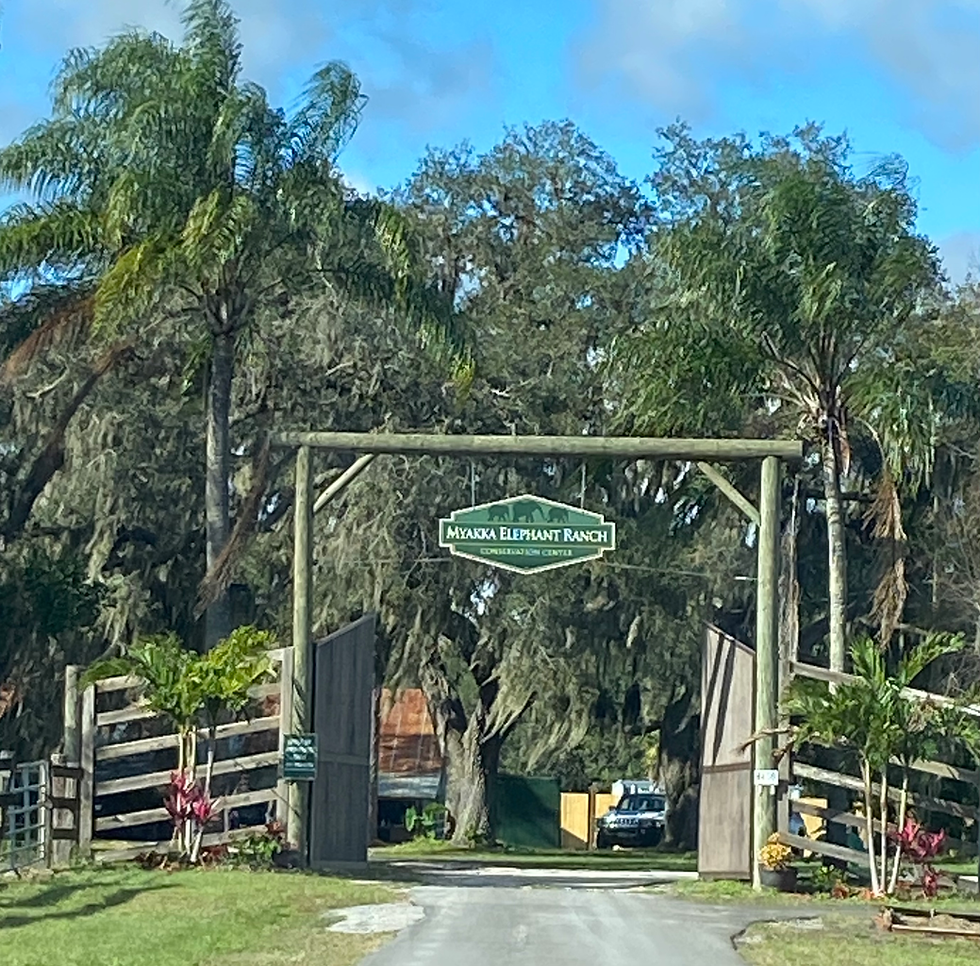
Florida’s Myakka Elephant Ranch
The Myakka Elephant Ranch is located far off the beaten track in dense Florida marshland, the closest thing Florida has to an African savanna. The 10-sprawling acre ranch located in Myakka City is a remote location that features two Asian elephants and one African savanna elephant.
All three pachyderms were out and about, roaming the grounds. The African elephant and matriarch of the group named Lou stood in the barn in front of an appreciative audience. Lou’s foot rested delicately on a stool as an excited guest painted her nails with healthy mineral oil. Her heavily lashed eyes were closed, looking just like someone being treated to a luxury mani-pedi. Was Lou enjoying the salon treatment or merely tolerating it?
“The main thing we do with the public is to let you help with their daily care,” began Lou Barreda, chief executive officer and president of the Myakka Elephant Ranch.
Lou was named after this Barreda family member and it’s clear that they also share a special bond, as elephant Lou nudges and teases her human “brother.”

“The main reason we wash the elephants is because water is very important for their skin and provides moisture,” Barreda said. “It keeps them from getting overly dry. They have to get a full bath at least once a day. We allow the public to come and help with their care.”
“Once you’ve had that one-on-one experience, it’s just in your heart,” said Julia Braren, Myakka Elephant Ranch’s sales director. “It tugs on the heartstrings once you get up close and personal and can understand. It’s part of what you want to contribute to: It’s such a beautiful thing. When you hear the statistics of their decline, you want to help save and preserve these majestic animals.”
An elephant never forgets
“Elephants are always looking for water,” explained Barreda. “If they find a good spot for drinking water, they’ll be back eventually. It could be five or 10 years later, but they never forget.”
This impeccable memory doesn’t apply just to drinking holes. “If someone in a crowd was nice to them or gave them lots of treats, they can pick them out of a crowd years later.”
Having an amazing memory isn’t the only gift possessed by the peaceful giants – they also have an incredible sense of smell. They can smell water miles away.
Barreda told the tale of a couple who went on a safari in Africa. The guide had everyone take their shoes off and put them in a pile. One of the elephants would pick up a shoe and take it to the person in the tour group that it belonged to.
Braren explained that Myakka Elephant Ranch is a nonprofit founded by Lou Barreda in October of 2019. After he graduated from Florida Gulf Coast University in 2018, Lou decided to go to South Africa to attend the 16th International Elephant Conservation and Research Symposium, which is a bi-annual event hosted by the International Elephant Foundation.
“He learned so much, meeting with world leaders and top professionals in the field such as Deborah Olson, who founded the International Elephant Foundation,” she said. “He was so moved by what he learned there that he decided to start a nonprofit focused on global elephant education and conservation right here in southwest Florida. And so Myakka Elephant Ranch was born.”
The dedication to conservation is at the forefront of every conversation at the ranch. “Here at Myakka Elephant Ranch we’re trying to expand. We would love to acquire the adjoining 10 acres and expand the elephant’s area that way, toward the road,” said Barreda.
Sadly, the elephant population is in a big decline. In 1930, 10 million elephants were roaming Africa: Today there are about 400,000 to 450,000 African elephants left. The Asian elephant is far more endangered, as there are only about 40,000 left on the planet.
The main reason for the tragic decline is ivory poaching. “Almost 100 elephants a day are killed due to poaching in Africa,” explained Barreda. “The human/elephant conflict is a big issue, especially for the Asian elephant. This past year in Sri Lanka they lost 420 elephants. The elephants killed 120 people, so they are battling it out over the land and the resources.”
Myakka Elephant Ranch has committed a portion of its proceeds to go directly to the Elephant Foundation by creating a partnership. “Right now, we are working on building anti-poaching ranger stations in Uganda. We’re excited about that partnership and hope to make a big difference. Locally, every bit of support and every conversation about elephant conservation really helps to support our three elephants year-round.”

Starting an elephant conservation ranch is not for the faint of heart. After leaving Africa, Lou Barreda went to Germany to intern at Wuppertal Zoo, a world-renowned facility.
“He learned from experts in the field of elephant care, behavior, communication, and species propagation,” explained Braren. “The Wuppertal Zoo is a world leader on the cutting-edge science of elephant artificial insemination, a practice almost impossible until recently. When used consistently, breeding and artificial insemination can help with conserving the elephant species and bring elephants from certain areas back from the brink of extinction. With this newfound knowledge, he returned to Florida ready to take on the massive project of building a nonprofit from the ground up.”
The first step was to develop experiences that would educate visitors about these amazing species. “We believe that education combined with experience will inspire people and lead to lasting conservation,” said Braren.
The history of elephants being held in captivity can be traced as far back as 1796 and there seems to be an oblique Florida connection.
“The America,” a sailing vessel captained by Jacob Crowninshield, arrived in New York Harbor from Calcutta, India. The ship’s log which was maintained by officer Nathaniel Hathorne (whose son, an author, would later add the “w” to the family name) stated that there was an “ELEPHANT ON BOARD.”
The elephant on board was a 2-year-old female, originally purchased by Crowninshield in Bengal for the bargain price of $450. She was immediately sold in New York for $10,000.
1796 just happens to be eight decades before the opening of the first zoo. The unfortunate elephant would spend the remainder of her days on circuslike exhibition tours up and down the Eastern Seaboard. It is an interesting sidenote that she developed a 30-bottle-a-day dark beer habit that she learned to open with her trunk.
Myakka Elephant Ranch has the support of the community. “I have been at the Myakka Elephant Ranch numerous times,” stated Cheryl G.*, a supporter of the ranch. “These elephants roam free through the acreage, and each is personally and gently cared for as a loved and highly respected member of "the family." These elephants are very affectionate with the staff. Visitors are allowed to be part of their daily care. There are no chains or bull hooks used and the elephants do not "perform." The Myakka Elephant Ranch is a wonderful sanctuary for elephants, and if you care about wildlife you should support the ranch, whether you physically visit and participate in caring for the elephants or not.”
At the Myakka Elephant Ranch, you will not be able to ride Lou, Cindy or Carol. The elephants do not perform tricks or poses and at no time are any devices used. They seem quite playful and relaxed as they interact with the audience members and the caretakers.
Most circuses have removed elephants from their performance lineup and in 2004 the Detroit Zoo became the first major American zoo to shut down its elephant exhibit, a decision based on ethical grounds. Two years later, the Bronx Zoo announced that it would close its exhibit after its three elephants died. In a 2012 investigation, the Seattle Times estimated that since the early 1990s more than 22 zoos had shut down their elephant exhibits or announced that they were phasing them out, including those in Seattle, San Francisco and Chicago.
In 2011, the Association of Zoos and Aquariums, the nonprofit organization that accredits and monitors zoos and aquariums in the United States and 10 other countries, in response to the growing awareness of the elephant’s true nature, imposed new minimum requirements for acreage and the number of elephants on exhibit. Because of that, closures were as much a result of economic considerations as well as moral.
“Over the years I’ve been told by so many people the elephants belong in the wild,” explained Braren. “Unfortunately, going to Africa and seeing the conditions they are facing … life in the wild is no longer what it used to be. Their life expectancy there is approximately half of the years they live in captivity, where we can protect them. About 100 elephants daily are dying in Africa from the extreme poaching for their ivory. Elephants in Asia are facing extreme conditions in the human-elephant conflict and many of them starving. Without our help, the elephants will not survive the terrible conditions they are facing. Conservation of these majestic giants is more important than ever. The more people who are educated and aware, the more of an impact can be made. Please help us in educating more people about the need for elephant conservation.”
The second demonstration of the day was set to begin as approximately 50 women, men, grandparents, and children find a spot in the barn bleachers. As Lou the elephant enters through the barn doors, the crowd audibly oohs and ah’s in delight. Barreda may have the microphone, but the audience only has eyes for the real star of the show, the other Lou.
Alfred Hitchcock famously said that he refused to work with animals or children, but it’s apparent that Barreda doesn’t agree. Cindy and Carol attempted to upstage his demonstration by bumping him playfully and extending their trunks into the audience, apparently looking for treats. But human Lou knows that Lou the elephant is the star of the show, and he wouldn’t want it any other way.
“The foundation of our organization is education, conservation, experience,” said Braren. “Sharing our love and knowledge of elephants has deeply impacted so many people along the way. Many people have such a connection and love for these animals. Being able to share how to protect them is so rewarding.”
“These elephants are really ambassadors to those in the wild, and now you all are here to learn to become ambassadors for them,” said Barreda as he addressed the audience. “Keep posting pictures and invite your friends and family to like our Facebook page so we can continue to educate more people on the need for elephant conservation. The more people who are aware, the bigger difference will be made and hopefully, we can save the elephants.”
For more information go to myakkaelephantranch.org.
*Last name withheld upon request.


Comments